SINA NAJAFI
TALKS ABOUT GENOCIDES WITH
EYAL WEIZMAN
Free, RSVP required
TALKS ABOUT GENOCIDES WITH
EYAL WEIZMAN
Free, RSVP required
Friday,
October 30, 2026
6:30pm
Doors
7pm
Event begins
Limited capacity
October 30, 2026
6:30pm
Doors
7pm
Event begins
Limited capacity
There is a clause in the 1948 United Nations Convention on the Prevention and Punishment of the Crime of Genocide that forbids, among other things, “deliberately inflicting on [a] group conditions of life calculated to bring about its physical destruction.” The intent of this clause is to cover indirect forms of killing—the targeting not of human bodies but of the environment that sustains them. It is also crucial for retroactively understanding the colonial origins of genocide.
The term “conditions of life” encompasses the environment understood broadly in its entangled natural, physical, and now digital manifestations: land, forests, and rivers, but also agriculture, housing, hospitals, schools, sewage and water systems, electrical grids, communication networks and digital infrastructure, and social and cultural institutions. The intentional destruction or degradation of these elements may not kill instantly but it undermines a people’s ability to survive, leading to a slower form of decline.
In his book Ungrounding: The Architecture of Genocide, the architect and writer Eyal Weizman writes about this principle in the context of the current Israeli genocide in Gaza.
The term “conditions of life” encompasses the environment understood broadly in its entangled natural, physical, and now digital manifestations: land, forests, and rivers, but also agriculture, housing, hospitals, schools, sewage and water systems, electrical grids, communication networks and digital infrastructure, and social and cultural institutions. The intentional destruction or degradation of these elements may not kill instantly but it undermines a people’s ability to survive, leading to a slower form of decline.
In his book Ungrounding: The Architecture of Genocide, the architect and writer Eyal Weizman writes about this principle in the context of the current Israeli genocide in Gaza.
In this event, writer Sina Najafi talks with Eyal about genocidal violence more broadly, and how while direct acts of massacre have been, and continue to be, perpetrated in colonized territories across the world, it is in fact slow, indirect killings that have more often been the means of annihilating Indigenous peoples. Dispossessed of their ancestral habitats, separated from the land on which they have depended for sustenance and ritual, forced into reservations, Indigenous populations everywhere have been destroyed to free up the best land for European settlement.
This necropolitical history frames Sina and Eyal’s discussion on the different modalities and velocities at which genocidal violence has been, and continues to be, perpetrated.
This event is co-presented with Cabinet magazine.
This necropolitical history frames Sina and Eyal’s discussion on the different modalities and velocities at which genocidal violence has been, and continues to be, perpetrated.
This event is co-presented with Cabinet magazine.
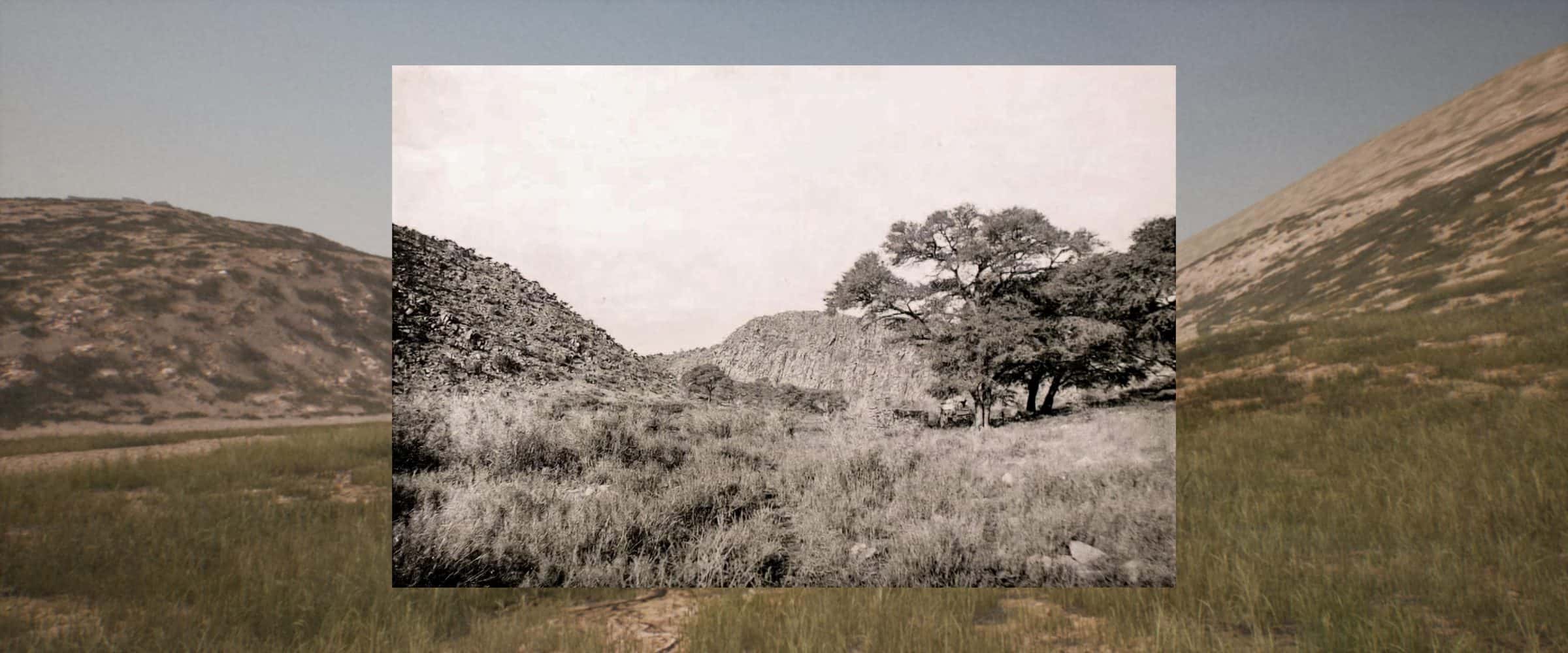
Photomatch of an 1897 photograph from Hatsamas, Namibia within our 3D digital reconstruction in Unreal Engine, confirming Indigenous accounts of the character of grasslands in this area. External image source: Deutsch-Südwest-Afrika, 96 Lichtdrucke nach photographien aus dem Herero- und Nama-Lande, Theodoor Rehbock, 1897. (Forensic Architecture/Forensis, 2025)
Eyal Weizman (b. 1970, Israel) is an architect, artist, and writer. In 2011 he founded Forensic Architecture, a research agency that provides architectural evidence in human rights cases and war crimes trial. In 2007, with Sandi Hilal and Alessandro Petti, he established the architectural collective DAAR in Beit Sahour/Palestine. He is the author of numerous books, including Ungrounding: The Architecture of Genocide, Hollow Land, The Least of all Possible Evils, Investigative Aesthetics, The Roundabout Revolutions, The Conflict Shoreline, FORENSIS, and Forensic Architecture: Violence at the Threshold of Detectability. He is a professor of Spatial and Visual Cultures at Goldsmiths, University of London, where in 2005 he founded the Centre for Research Architecture. He lives in London.
Sina Najafi (b. 1965) is a writer and editor. He is the editor-in-chief of Cabinet magazine
and editorial director of Cabinet Books. He lives in New York and Berlin.
and editorial director of Cabinet Books. He lives in New York and Berlin.
Due to the age and character of the building, the space is not optimized for ADA accessibility and is located up a single flight of 20 stairs with handrails. If you have questions about access, please contact us in advance of the event, and we will make every effort to accommodate you.
