MÓNICA DE LA TORRE,
LUCÍA HINOJOSA GAXIOLA
AND ANDROS ZINS-BROWNE
TRY TO READ
MIRTHA DERMISACHE
LUCÍA HINOJOSA GAXIOLA
AND ANDROS ZINS-BROWNE
TRY TO READ
MIRTHA DERMISACHE
Thursday,
November 5, 2026
6:30pm
Doors
7pm
Event begins
Limited capacity
November 5, 2026
6:30pm
Doors
7pm
Event begins
Limited capacity
In Argentina of the 1970s, dissent was dangerous. The polarization of discourse lay the foundations for the Dirty War waged by the Military Junta that ruled the country from 1974 to 1983.
In 1972, the artist Mirtha Dermisache published Diario 1, Año 1 for the “Art and Ideology” outdoor exhibition organized by the Centro de Arte y Comunicación (CAYC) in Buenos Aires. In its format, her piece resembled a typical newspaper, yet it was composed of eight pages of what she coined as “graphisms”: illegible writing closer to scribbles or drawings. Copies of her Diario were distributed gratis and left on park benches for a couple of days before the exhibition was forced to shut down for featuring works that alluded to the massacre of sixteen political prisoners.
Dermisache wanted her works to be read, not simply seen or shown preciously in an exhibition space. She saw the act of reading as a liberatory practice essential to a participatory democracy. Abstraction could be a way to stand up to oppressive acts of political disinformation.
In 1972, the artist Mirtha Dermisache published Diario 1, Año 1 for the “Art and Ideology” outdoor exhibition organized by the Centro de Arte y Comunicación (CAYC) in Buenos Aires. In its format, her piece resembled a typical newspaper, yet it was composed of eight pages of what she coined as “graphisms”: illegible writing closer to scribbles or drawings. Copies of her Diario were distributed gratis and left on park benches for a couple of days before the exhibition was forced to shut down for featuring works that alluded to the massacre of sixteen political prisoners.
Dermisache wanted her works to be read, not simply seen or shown preciously in an exhibition space. She saw the act of reading as a liberatory practice essential to a participatory democracy. Abstraction could be a way to stand up to oppressive acts of political disinformation.
The poet Mónica de la Torre wrote about Dermisache in her 2020 anthology Women in Concrete Poetry 1959–1979, placing her work not only within the history of poetry but the socio-political history of Latin America more broadly. She, too, wants Dermisache’s texts to be read.
Monica gives an overview of Dermisache’s work and then invites two guests to read pages from the Diarios.
Lucía Hinojosa Gaxiola is thinking about the body of the text in relation to the body of the reader. She’s interested in how the gestures of asemic letters can transform into haptic sound, a form of sensorial communication that happens before semiotic meaning. Her reading reinterprets Dermisache’s poems as experimental scores that are reread and amplified with synthesizers, field recordings, objects, and many contact microphones.
Andros Zins-Browne is interested in the headline, the paragraph, the sentence, their fonts and indents; in the columns—how they fall, slip, and undermine—as choreographic devices. His performance embodies Dermisache’s graphism through a series of dancing “articles” of concrete poetic movement.
Both performances might bleed into each other.
The evening ends with a surprise—a collective attempt to experience the sonority of many languages you don’t understand.
Monica gives an overview of Dermisache’s work and then invites two guests to read pages from the Diarios.
Lucía Hinojosa Gaxiola is thinking about the body of the text in relation to the body of the reader. She’s interested in how the gestures of asemic letters can transform into haptic sound, a form of sensorial communication that happens before semiotic meaning. Her reading reinterprets Dermisache’s poems as experimental scores that are reread and amplified with synthesizers, field recordings, objects, and many contact microphones.
Andros Zins-Browne is interested in the headline, the paragraph, the sentence, their fonts and indents; in the columns—how they fall, slip, and undermine—as choreographic devices. His performance embodies Dermisache’s graphism through a series of dancing “articles” of concrete poetic movement.
Both performances might bleed into each other.
The evening ends with a surprise—a collective attempt to experience the sonority of many languages you don’t understand.
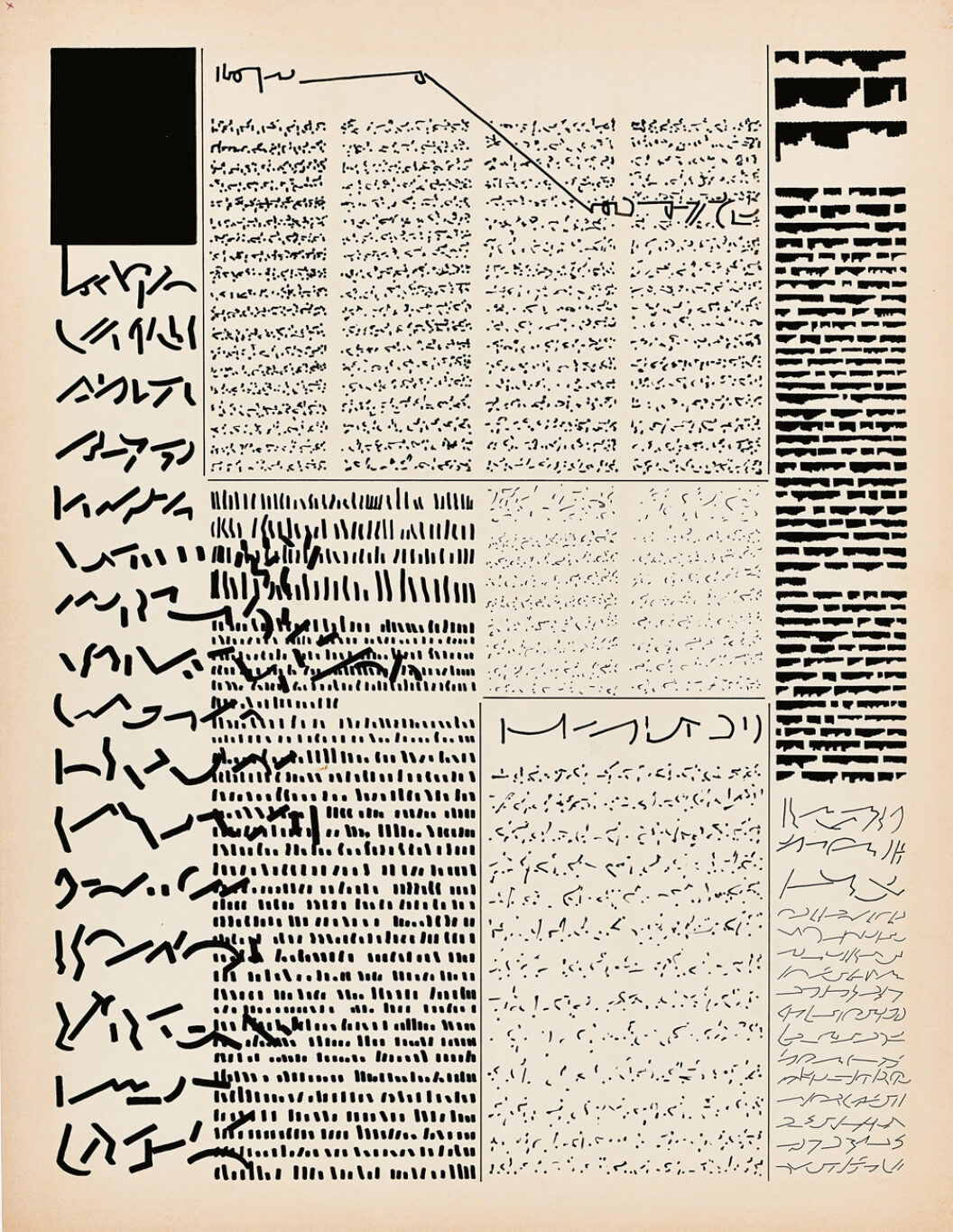
Mirtha Dermisache, Diario Noº 1 Año 1, 1972, Chinese ink and marker on paper, 18 3/16 × 14 1/8 inches
Mirtha Dermisache (1940 - 2012, Argentina) finished her first 500-page book in 1967, after which she continued with the development of her graphisms. In 1971, she opened the Taller de Acciones Creativas (TAC), a space for the teaching of different art techniques with the aim of developing the creative capacity and free graphic expression in adults. From 1975 to 1981, she ran the public Jornadas del Color y de la Forma (Intensive Work Sessions in Color and Form).
Mónica de la Torre (b. Mexico) is a poet, translator, and scholar. Her books of poetry include Pause the Document (2025), Repetition Nineteen (2020), and The Happy End/All Welcome (2017). She coedited, with Alex Balgiu, the anthology Women in Concrete Poetry 1959–79 (2020), and, with Michael Wiegers, the collection Reversible Monuments: Contemporary Mexican Poetry (2002). She teaches poetry and translation at Brooklyn College’s Creative Writing M.F.A. program.
Mónica de la Torre (b. Mexico) is a poet, translator, and scholar. Her books of poetry include Pause the Document (2025), Repetition Nineteen (2020), and The Happy End/All Welcome (2017). She coedited, with Alex Balgiu, the anthology Women in Concrete Poetry 1959–79 (2020), and, with Michael Wiegers, the collection Reversible Monuments: Contemporary Mexican Poetry (2002). She teaches poetry and translation at Brooklyn College’s Creative Writing M.F.A. program.
Lucía Hinojosa Gaxiola (b. 1987, Mexico) is a poet, artist, and performer. Her poetry books include Templos en erupción (Juan Malasuerte, 2025); The Telaraña Circuit (Tender Buttons, 2023); and O (EBL/Cielo Abierto, 2023) and she has released albums of experimental music and poetry. With Diego Gerard Morrison, she runs and co-edits diSONARE, an experimental editorial platform that publishes bilingual journal-anthologies and books in-translation. She lives in Mexico City.
Andros Zins-Browne (b. 1981, USA) works at the intersection of performance and dance. He has performed at the Hammer Museum, Los Angeles; Institute of Comtemporary Arts, London; the Whitney Museum, New York; Rockbund Art Museum, Shanghai; and Fondation Galeries Lafayette, Paris, among others. He lives in Brooklyn.
Andros Zins-Browne (b. 1981, USA) works at the intersection of performance and dance. He has performed at the Hammer Museum, Los Angeles; Institute of Comtemporary Arts, London; the Whitney Museum, New York; Rockbund Art Museum, Shanghai; and Fondation Galeries Lafayette, Paris, among others. He lives in Brooklyn.
